The EU–India Free Trade Agreement (FTA), signed on 27 January 2026, represents one of the most consequential trade pacts ever concluded between two major democratic economic blocs, marking the political culmination of negotiations that spanned nearly two decades and were repeatedly stalled by disagreements over tariffs, services, investment protection, and regulatory alignment.
The signing ceremony at Hyderabad House in New Delhi, attended by India’s Prime Minister Narendra Modi, European Council President António Costa, and European Commission President Ursula von der Leyen, symbolized not only the conclusion of a long‑awaited negotiation cycle but also the beginning of a new strategic era in EU–India economic relations.
The agreement is framed as a modern, rules‑based, comprehensive partnership designed to unlock opportunities for over two billion people across both regions, with the explicit aim of strengthening supply chains, boosting trade flows, enhancing innovation, and positioning both partners as central actors in a rapidly shifting global economic landscape.
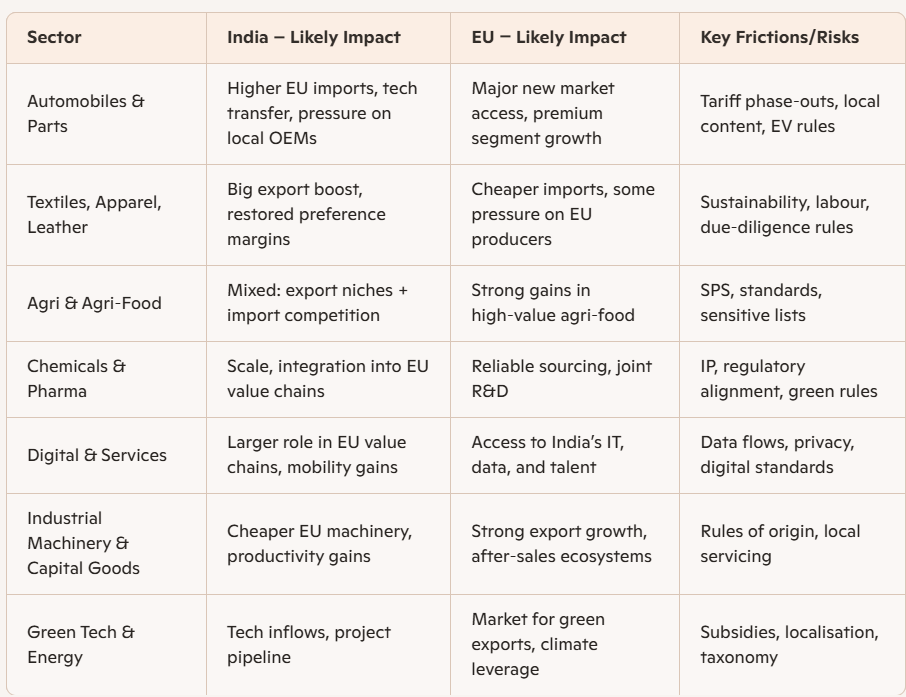
For the EU, the FTA serves multiple strategic objectives: diversifying supply chains away from over‑dependence on China, expanding export opportunities in industrial goods, agri‑food, pharmaceuticals, and high‑value manufacturing, and reinforcing its geopolitical presence in the Indo‑Pacific. For India, the agreement is equally transformative, offering unprecedented market access for more than 99% of its exports, supporting its long‑term development vision under India@2047, and enabling Indian industries—from textiles and machinery to chemicals, pharmaceuticals, and processed foods—to integrate more deeply into European value chains. The FTA is expected to significantly increase bilateral trade, which already reached €120 billion in goods in 2024, and to support India’s export ambitions, including its target of INR 6.4 lakh crore in exports to the EU in 2024–25.
Despite the political conclusion, the agreement does not enter into force immediately upon signature. Instead, it must undergo a rigorous ratification process on both sides.
On the EU side, the process begins with legal scrubbing—a detailed verification of the treaty text to ensure consistency, accuracy, and legal coherence—followed by translation into all 24 official EU languages, a step that historically takes between six and twelve months. Once the final text is prepared, the European Commission formally submits it to the Council of the European Union, which must approve the agreement. If the FTA is classified as a “mixed agreement”—which is likely, given the inclusion of investment protection and regulatory cooperation chapters—then the Council must approve the investment components unanimously, while the trade components may be approved by Qualified Majority Voting (QMV). After Council approval, the agreement moves to the European Parliament, which must give its consent by a simple majority vote. The Parliament cannot amend the treaty; it can only accept or reject it. Once Parliament consents, the EU formally notifies India that it has completed its internal procedures. However, if the agreement is indeed mixed, the process does not end there: all 27 EU member states must ratify the investment‑related chapters through their national parliaments, and in some cases, regional parliaments (such as Belgium’s Wallonia), a step that has historically introduced delays—as seen in the EU–Canada CETA ratification.
On the Indian side, the ratification process is more streamlined but still significant. India must secure approval from the Union Council of Ministers, and depending on the nature of the commitments, parliamentary scrutiny may also be required. Once India completes its domestic procedures, it issues a formal notification to the EU. Only after both sides exchange notifications does the agreement enter into force, typically on the first day of the second month following the exchange, in line with standard EU treaty practice. Based on the timelines of previous EU FTAs—such as EU–Japan (7 months for legal scrubbing and translation, 5 months for parliamentary approval), EU–Vietnam (11 months for legal scrubbing, 4 months for parliamentary approval), and EU–New Zealand (approximately 3–5 months for institutional approvals)—a realistic projection places the entry into force of the EU–India FTA in early 2028, most likely January or March 2028, assuming no major political or procedural delays.
The agreement’s substantive content is equally ambitious. It covers trade in goods, services, digital trade, intellectual property, rules of origin, customs facilitation, sanitary and phytosanitary measures, technical barriers to trade, sustainable development, dispute settlement, and institutional provisions. One of the most impactful components is the tariff liberalization schedule.
While the full tariff schedules are not yet publicly released in their final legal form, publicly available summaries indicate that India will reduce or eliminate tariffs on a wide range of European products, including automobiles, automotive components, wines, spirits, chocolates, machinery, pharmaceuticals, medical devices, and specialty chemicals. Conversely, the EU will eliminate tariffs on nearly all Indian exports, including textiles, apparel, leather goods, engineering products, chemicals, agricultural products, and processed foods. This is particularly significant given that Indian exporters recently lost preferential tariff margins under the EU’s Generalised Scheme of Preferences (GSP), resulting in higher duties on products such as textiles and clothing, where MFN tariffs can reach 12%. The FTA is expected to restore and expand preferential access, improving competitiveness for Indian exporters across key sectors.
Beyond tariffs, the agreement includes modern provisions on digital trade, data flows, regulatory cooperation, and sustainable development. It aims to create predictable, transparent, and business‑friendly conditions for companies on both sides, reducing non‑tariff barriers and aligning standards where feasible. For India, this means greater access to European technology, investment, and regulatory expertise; for the EU, it means access to one of the world’s fastest‑growing large markets, with a young workforce and expanding industrial base. The FTA also supports broader geopolitical objectives: strengthening the EU’s presence in the Indo‑Pacific, supporting India’s rise as a global economic power, and creating a counterweight to China’s influence in global trade architecture.
From an operational perspective, companies in both regions must prepare for significant changes in customs procedures, rules of origin, supply‑chain documentation, and compliance requirements. The agreement’s rules of origin are expected to be more flexible than India’s existing FTAs, enabling smoother integration into global value chains. Customs and trade facilitation chapters will streamline procedures, reduce clearance times, and promote digital documentation. For companies like Garuda Supplies, which operate across global vendor ecosystems, the FTA will require updates to vendor onboarding workflows, tariff classification systems, compliance frameworks, and supply‑chain planning models. The agreement’s phased tariff reductions—some immediate, others over 5–10 years—mean that companies must model cost trajectories and adjust procurement strategies accordingly.
In summary, the EU–India FTA is a landmark agreement that promises to reshape bilateral trade, strengthen strategic ties, and unlock new opportunities across sectors. Its entry into force, projected for early 2028, will depend on the completion of complex ratification processes on both sides. Once operational, the agreement will create the world’s largest free trade zone by population and one of the most economically significant by GDP, offering transformative benefits for businesses, consumers, and policymakers.
Unlock New Opportunities in India & the EU
The EU–India Free Trade Agreement is reshaping global supply chains. If you're exploring sourcing, vendor audits, contract negotiation, compliance, or market entry, Garuda Supplies is here to guide you every step of the way.